
Tracing Lynchburg Former Owners
Start from a parcel you know. The newest recorded deed names its grantee and grantor. The earlier grantor is your next grantee. Lynchburg splits its online access, with regular SRA coverage from 1956 and special grantor-grantee books covering 1937 to 1978. The Circuit Clerk's physical land records reach back to 1805. Check the legal description at every step. A street address can change, a tract can split, and one deed may describe only part of a larger holding.
| Source | Years It Covers | Where Held | What It Shows |
|---|---|---|---|
| Virginia SRA land index | 1956 to present for deed images | Circuit Court Clerk | Recent deeds and attached plats when available |
| Special grantor-grantee books | 1937 to 1978 | SRA special-index route / Clerk | Party entries across the older index period |
| Physical land records | 1805 to present | Clerk public records area | Older deed books and records not online |
| City directories and plats | Directories 1873 to present; plat coverage varies | Jones Memorial and Clerk | Address, household context, lot and subdivision clues |
Begin in SRA with a recent owner's name. Pull the recording reference from that entry. Use the special index for its stated years, then ask at the Clerk's public records area about deed books and earlier holdings. A plat ties a lot and block to a recorded map, and a directory ties an address to a former occupant. Neither one replaces the deed. The Clerk publishes no exact earliest online index year before the special books.
Reading a Lynchburg Deed Chain Backward
Write each transfer down as a row. Memory will fail you. For every deed, log its date, parties, type, reference, consideration if shown, and legal description. Descriptions can shift over time. When a lot becomes part of a tract, search the parent tract and its neighbors, and remember that a deed of gift, fiduciary deed, correction, or boundary agreement is not always a sale. Treat each document as what it says.
- Find the latest deed with the current owner as grantee.
- Write down the grantor, instrument type, date, and legal description.
- Search that grantor as grantee for the earlier deed.
- Compare parcel, subdivision, lot, block, and acreage at every transfer.
- When an online range ends, continue in the Clerk’s physical records or special books.
- Grantor and grantee
- The parties named as transferor and recipient in a recorded document.
- Chain of title
- The ordered record of transfers and related instruments tied to the parcel.
- Legal description
- The land description used in a deed or plat, often more stable than a street address.
- Quitclaim and warranty
- Deed forms with different promises about the interest conveyed; inspect the actual instrument.
How Far Back Lynchburg Owner Records Reach
Lynchburg's paper deed records start in 1805. The published remote SRA coverage starts in 1956. The special grantor-grantee books cover 1937 to 1978. No published year marks the earliest ordinary online index before 1937. No official record confirms a courthouse fire or a destroyed land-book period. A missing online result never proves a transfer did not happen, so ask the Clerk or consult the relevant finding aid instead. Deeper chain research can pull in deed books, plats, probate files, and Library of Virginia records programs. A prior owner's death may have produced a fiduciary matter, List of Heirs, Real Estate Affidavit, or executor deed in the Circuit Court. Estate transfers break a tidy buyer-seller sequence. Search both land and probate names. Compare the legal description at each step. The Clerk's Deeds page states the 1805-present local record span and the public counter route. Virginia's SRA access page explains the split between index-only access and subscriber images.
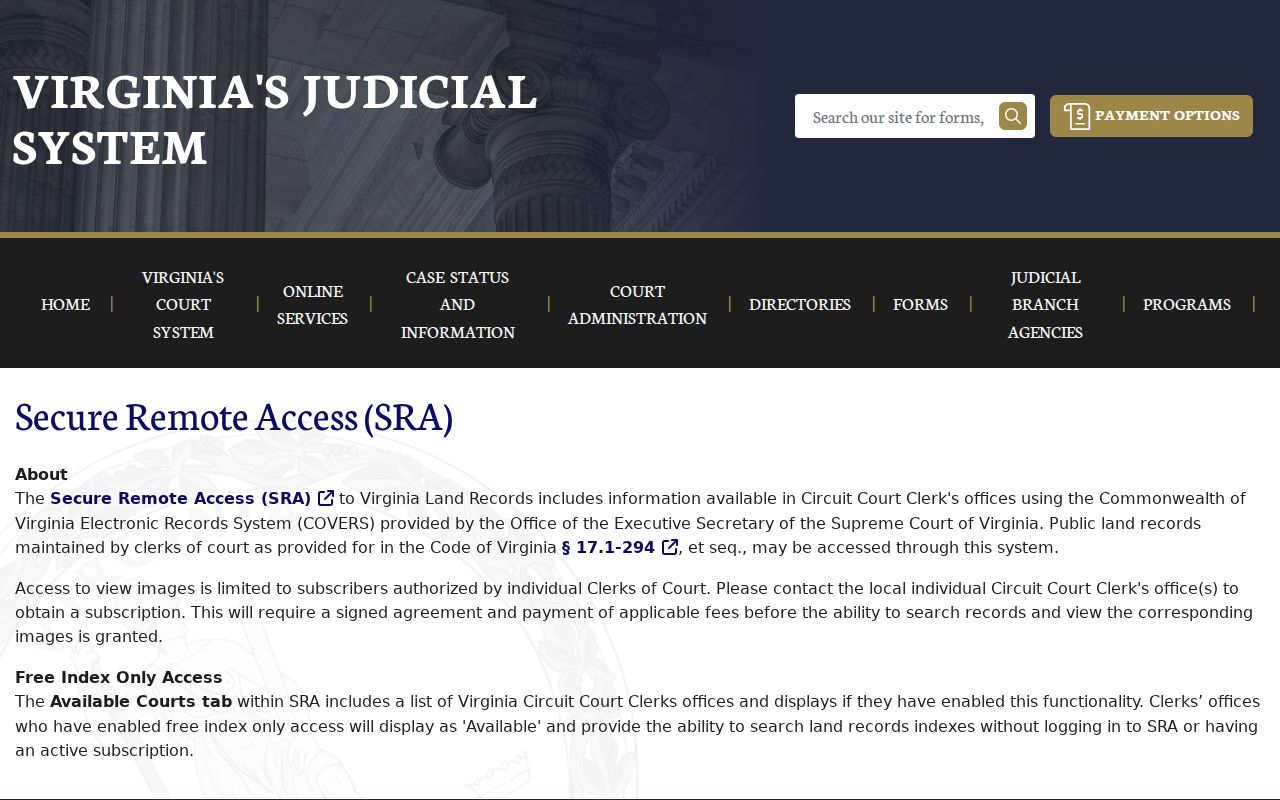
The SRA access view shows why older ownership research can require a physical-book fallback.
Lawful use. Use Lynchburg former-owner records for property history and due diligence. Do not use them to track, threaten, or harass a living person.
Lynchburg Special Index and Online Cutover
The special grantor-grantee route covers 1937 to 1978. The listed SRA deed images begin in 1956. Those ranges overlap rather than forming a single cutover. Search the special index for an older party entry, then follow its book, page, or instrument reference to an image or a paper volume. The sources publish no earliest standard online index year before the special books. Remote Lynchburg image access runs on subscription. Free index-only access depends on the Clerk enabling it. The Clerk lists $50 per month, $270 for six months, or $480 per year. The original subscriber application must be mailed and notarized. For one-off discovery and older volumes, the public records area is the practical alternative. A chain that stops online needs a physical search, not a guessed year.
Former Lynchburg Owners in City Directories
Jones Memorial Library holds a complete printed Lynchburg City Directory run. It spans 1873 to the present. Its shelves also offer microfilm readers, family files, and architectural plans. A local marriage and death index covers 1795 to 1836. Selected scans online include 1873, 1875-76, 1876-77, 1879-80, 1881, and 1909. No scan replaces the paper run. A directory entry can pair a historic street address with a person, occupation, or household clue. Use directories to bridge an address gap. They can also suggest a likely period of occupancy. Verify ownership in the deed records themselves. A directory year and a census year rarely line up. A resident is not automatically the owner of record. The Jones Memorial research page describes the holdings. Lynchburghistory's directory scans offer selected digitized issues.
Estate Transfers in Lynchburg Chains
A death in the ownership line often looks like a gap in Lynchburg property records. The Circuit Court Probate Division handles wills and fiduciary filings. Its Clerk's land records may hold a List of Heirs. They may also hold a Real Estate Affidavit or an executor or administrator deed. Fees are posted at $68 for the List of Heirs and $69 for the Real Estate Affidavit. To trace the transfer, search the former owner, the fiduciary, and the legal description. Do not stick to a simple buyer-seller pattern.
A will alone is not the recorded land instrument. Pull both the probate file and the deed reference. Then check that the legal description tracks the same parcel. Watch for mortgages too. An old mortgage in the chain is not automatically settled. Look for a later certificate of satisfaction or release before moving on. Every entry in a former-owner timeline should name the actual document type behind the transfer.
Historic Lynchburg Lots and Plats
Old plats solve a common puzzle in Lynchburg deed work. A chain of title often shifts from street addresses to lot, block, or parent-tract wording. The plat explains the switch. The city's Parcel Viewer shows legal lot, block, and subdivision labels. Recorded plats and deed attachments live with the Circuit Clerk. Attached plats appear in SRA from 1956 forward when available. Need older maps? Try the public records room. Library of Virginia finding aids and local-history collections help too. Federal Hill shows why place-specific time markers matter. It held about eight houses when annexed from Campbell County in 1819. That history points you toward older deeds and directory entries. It cannot name a prior owner by itself. Confirm every transfer in the recorded chain. Let the plat establish how the land was described at that date.
Name Variants in Lynchburg Deed Research
Party indexing can scatter one person's trail. Initials, spelling variants, marital names, and entity suffixes each split the record. Search the same owner as grantor and as grantee. The index route may not run the direction you expect. A deed of gift, deed of correction, boundary-line agreement, or fiduciary deed also alters the chain. It does so without a typical sale entry. A research log keeps the work straight. Record the parcel ID, current owner of record, latest grantee deed, recording date, grantor, instrument type, and legal description. Add the next backward search name too. When a document describes part of a larger tract, compare parent-tract and adjoining-owner references. The Lynchburg deed-records page covers instrument access and copy routes. The former-owner trail uses those same deed records to rebuild sequence and time depth.