
Lynchburg Tax Record Fields and Sources
Two Lynchburg offices divide the tax work. The Assessor maintains the ownership roll for the July 1 to June 30 tax year. It also tracks current property characteristics. Billing and Collections answers real-estate bill and payment questions. The Treasurer keeps payment records too, but its page routes real-estate inquiries to that unit. The City publishes no public bill-search URL. A parcel card lookup plus a direct call remains the supported path.
| Field | What It Shows | Where |
|---|---|---|
| Assessed value | City valuation used in the real-estate tax calculation | City Assessor / Parcel Viewer |
| Land and improvements | Parcel components and physical-characteristic basis | City Assessor / Parcel Viewer |
| Exemption or deferral | Relief, rehabilitation adjustment, or land-use deferral shown for a parcel | Assessor card and program office |
| Bill and payment status | Amount due, receipt, or delinquency information | Billing and Collections |
| Tax-sale notice | Parcel, case, legal description, and sale information when published | City auction notice / Circuit Court |
The 2025 reassessment notice set Lynchburg's assessed value at 100 percent of fair market value on its valuation date. That statement describes the level of assessment. It does not promise each parcel would sell for its assessed figure. A deed may record consideration paid. A bill simply applies the adopted rate to taxable value. For how those numbers differ, see the separate Lynchburg property value explanation.
Finding a Lynchburg Tax Bill
Pull the assessor card first. A bill inquiry goes smoother with the exact parcel ID and tax year in hand. The Parcel Viewer is the free, supported way to look up an address or owner. It also retrieves the City's assessment information. The City posts no public page showing a full bill balance with payment history. The Treasurer maintains payment records. But its page directs real-estate bill questions to Billing and Collections at 434-455-3850.
- Find the parcel in the Lynchburg Parcel Viewer and copy the full ID and situs address.
- Call Billing and Collections at 434-455-3850 for a real-estate bill or payment question.
- Ask which tax year and parcel the balance covers, and whether a relief amount is on the assessment card.
- For a delinquency or auction notice, confirm the City’s current status and the related court file.
- Assessed value
- The City’s assigned value used in taxation, subject to applicable relief or deferral.
- Tax rate
- The amount applied per $100 of assessed value; Lynchburg’s published 2025-26 rate was $0.84.
- Tax relief
- A local program or exemption that changes the qualifying owner’s tax treatment.
- Tax lien
- A claim tied to unpaid taxes; check City and court records for the applicable status.
Challenging a Lynchburg Assessment
Lynchburg lays out three review levels. Start with an administrative review by the Assessor. It can be requested online, in person, by mail, or by calling 434-455-3830. From there, an owner may apply to the Board of Equalization by the deadline on the assessment notice. Supporting documents can be submitted with that application. The last route is a Circuit Court petition for an adjusted value. No attorney is required for the court route, the City says. An owner may still choose to consult one.
The Board process carries an evidence burden. The Assessor's value is presumed correct. So an appeal needs substantial evidence of non-uniform assessment or value above fair market value. A packet can include the notice, parcel ID, corrected building facts, photos, and comparable sales. The 2025 cycle set an early-April deadline for administrative review. The Board deadline that year was June 30. The 2026 notice told affected owners to contact the Assessor by August 7, 2026, a date now passed. Confirm future deadlines with the City.
Appeal window. Use the deadline on the notice for the specific assessment year. Lynchburg’s published 2026 contact deadline was August 7, 2026; ask the Assessor for any later or next-cycle dates.
Lynchburg Tax Year, Rate, and Bill Calculation
The Assessor's ownership roll follows a July 1 through June 30 tax year. To read a bill, keep three things together. You need the parcel's taxable assessment, that year's adopted rate, and any relief or deferred amount. Lynchburg's published rate for 2025–2026 is $0.84 per $100 of assessed value. The City sets rates with the annual budget. Check before carrying that figure into another tax year.
A rough calculation starts with taxable assessed value divided by 100. Then multiply by the rate. Relief, exemptions, credits, and deferrals can change the amount due. A payment record may reflect a balance from another period. For an account's actual charge, due date, payments, and balance, the bill and Billing and Collections are the source. The City Assessor's page gives the published assessment and rate context.
Lynchburg Assessment Search and Card Details
The City FAQ names three lookup keys. The full search-screen labels vary, but those fields are the documented starting points. Once a card opens, gather the owner, situs, mailing address, parcel ID, and legal lot or subdivision. A bill or relief question may turn on a field you cannot see. Ask the Assessor to clarify the card. Guessing tax status from a map is a bad habit.
| Search key | Type | Required | Use |
|---|---|---|---|
| Address on notice | Street address | One key | Find the situs card for the parcel |
| Full name | Text | One key | Search the owner or entity shown on the roll |
| Parcel number | Exact text | One key | Carry the parcel between assessment and map records |
The City reports about 32,525 real-estate parcels and 1,645 exempt parcels. Transfers and permits are processed all year. General reassessment, though, happens every other year. That distinction matters when you compare a current parcel card against a citywide valuation year.
A card may show a deferred amount. It can be tied to land use or an eligible rehabilitation program. A deferral is not an exemption. It is not the ordinary assessed value either. It can affect future tax treatment without touching the parcel's legal description. Ask the Assessor which program and tax year a card entry represents. Then ask Billing and Collections about the amount actually due.
Lynchburg Reassessment Dates and Value Review
Lynchburg pegged its 2025 reassessment to July 1, 2025. That date anchors the market value every figure in the cycle must reflect. The City also compares properties and updates physical characteristics. Renovations drove the 2026 changes instead. A separate 2026 notice attributes that year's shifts to additions, new construction, subdivisions, and rezoning rather than any citywide reassessment. The next citywide effective date is July 1, 2027. Assessment-change notices were expected in early March. Administrative review for that cycle closed in early April. The Board deadline was June 30, and none of those dates should be reused for a later appeal. A 2026 notice set August 7, 2026 for contacting the Assessor about that year's changes, so current notices are the source for the next calendar. Lynchburg's reassessment calendar spells out the 2025 dates and the full review process.
The calendar helps keep the assessment year and the proper review deadline together.
Relief Programs for Lynchburg Property Tax
Lynchburg's local tax-relief program serves homeowners who live in the home and are at least 65 or permanently disabled. Income and net-worth limits apply. Applications come out in June. They are due August 1 and filed annually. The disabled-veteran exemption requires ownership, occupancy, and a 100-percent permanent-and-total service-connected disability, and the City also describes terms for an eligible surviving spouse.
The rehabilitation program is narrower. It covers qualifying improvements, not the whole assessment or the tax rate. The structure must be at least 50 years old. The improvement value must rise by at least 40 percent. The fee is $125 and the term is 10 years. File before work starts, finish within two years, keep taxes current, and get a permit when required. Land-use deferral is a different classification. Qualifying agricultural parcels generally need five acres and bona fide use, and a deferred amount may appear in the Parcel Viewer even when the mailed notice leaves it out. The City forms page lists the review and mailing-address forms.
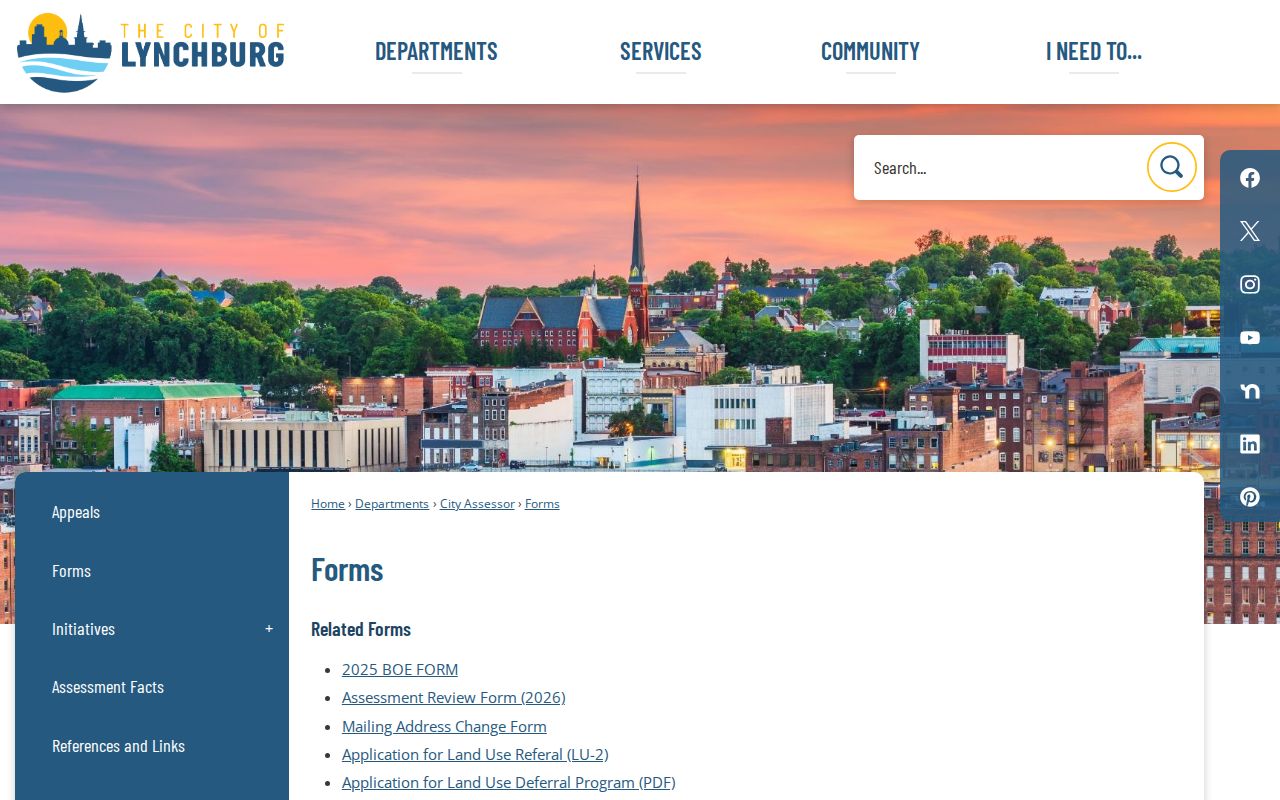
Use the current form and follow the notice instructions for whichever relief program fits the parcel's situation.
Lynchburg Delinquency and Auction Notices
Lynchburg may auction real estate after collection attempts fail. The trigger is taxes at least two years plus the current year in arrears. Auction questions go to Billing and Collections at 434-455-3850. The notices pack in detail. A single notice can carry a case caption, date, time, and place, plus the parcel sequence, address, lot and section, deed book and page, and plat cabinet and slide. It may also list the tax-map number, improvement status, square footage, and assessed value. That detail makes the notice a useful cross-check. It is not the final conveyance, though. Confirm whether the sale proceeded, was postponed, or was redeemed. Then check the court file and the final deed. An old bill, a listed auction date, or a mortgage never proves a sale, and City collections, the Circuit Court, and the Clerk each hold different pieces of the record trail. The Treasurer page routes real-estate tax questions to Billing and Collections.
The routing guidance sends bill questions to the right office.